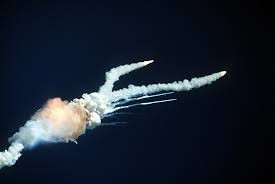
Forty years later, I remember the moment like it was yesterday. It was late morning, the sunlight trying to filter through an overcast sky. Not unusual weather for January in Cleveland. I was working on physics or math homework while sitting at my dorm room desk. That consisted of the right-hand end of a long strip of white Formica that ran the width of the room in front of the windows. Two sets of drawers separated my roommate’s desk from mine. In the corner where the wall met the window my clock radio sat playing a country station.
Then abruptly a song stopped halfway through. The DJ came on air and informed us that the space shuttle Challenger had just exploded shortly after takeoff. I sat there for a moment in disbelief, looked over at the model of the space shuttle sitting on my roommate’s shelf, and then finally hurried downstairs. A group of students had already gathered around the television in the first-floor lounge. I don’t recall how long we sat there in stunned silence, watching replay after replay of the Challenger’s takeoff and explosion.
Flashbulb memories
Forty years later I can still remember all those details because the Challenger disaster is a flashbulb memory for me. Flashbulb memories form when an unexpected event triggers strong emotional reactions, searing into memory details that normally would be forgotten as unimportant. Such as the weather or the type of music I was listening to.
The Challenger disaster happened during my first year in college. I was studying physics and most of my friends were studying some type of engineering. To us, the space shuttle represented the height of scientific exploration and engineering accomplishments. The morning of January 28, 1986 rocked our world.
It seems to me that something similar is described in the last chapter of John’s gospel. After Christ’s resurrection, John, Peter and others returned to Galilee and went fishing like they had done before they met Jesus. After a long night catching nothing, I imagine they were wondering if they had lost their touch. Then Jesus unexpectedly shows up and tells them where to throw their net for a big catch. Just like he had done when they first met him. When they get to shore, he already has breakfast waiting for them and they talk about the future.
An eyewitness account
This passage reads differently from much of the rest of the gospel. The pace of action is much slower, with limited discourse or objective lessons. Rather, it provides a lot more descriptive detail. John names five of the seven disciples on this fishing trip. He tells us which side of the boat they lowered the net, and how far from shore they were. He describes Peter putting on his outer garment, then jumping in the water and swimming to the shore. John describes a fire burning on the shore with fish and bread, giving us the only description we have of Jesus preparing a meal. He tells us that there were exactly 153 fish in the net. He describes in detail a conversation between Jesus and Peter that was personal in nature. The passage seems to me less of John teaching us about Jesus than sharing with us an event that was deeply meaningful to him.
The gospel of John is the only one that explicitly claims to be an eyewitness account. The opening prologue declares, “We have seen his glory” (John 1:14). The description of Jesus’ death finishes with an affirmation, “The man who saw it has given testimony” (John 19:35). The book concludes with the declaration, “This is the disciple who testifies to these things. We know that his testimony is true.” (John 21:24).
But who is the “we”?
Now, some people have argued that, since these are not individual, first-person claims, John is not truly the author. But we must be careful about reading an ancient text through the lens of our own culture’s practices and conventions. Today, authors generally write individually, only getting others involved for revisions, editing, etc. But we also have fairly high levels of literacy throughout our society. And with word processing software, it is easy for a person to write and revise until it sounds good. That’s how these blog posts get written. But things were different two thousand years ago.
For starters, universal education didn’t exist. Boys only received the level of education that their family could afford. For a working-class Galilean Jew like John, that was likely just enough to read the Hebrew Scriptures. He probably didn’t even begin learning Greek until an adult and started traveling outside of Aramaic speaking Palestine. Paper and ink were not cheap, and there was no ‘undo’ button on a parchment. People didn’t write a draft and then revised it; one had to revise it orally before committing the final text to writing.
Scribes and ghostwriters
For the reasons described above, it was a common practice two thousand years ago to employ the services of a scribe when writing a significant text. These did not merely write down the words, though. Having an experienced writer helping to compose the text was valuable in an age before White-Out. Rather, these scribes actively participated in shaping the text, phrases, and the like. Even the apostle Paul engaged a scribe named Tertius when composing his letter to the church in Rome (Romans 16:22). Note that Paul grew up speaking Greek, he studied under the greatest rabbinical teacher of his day and was known for his oratorical skills.
In contrast to Paul, the apostle John was a hick from the cultural backwater of Galilee. He would have had limited formal education. His native language was Aramaic, and whatever Greek (the lingua franca of the day) he would have learned later in life. People who learn a language as adults rarely develop native fluency. Nor would he likely have acquired the experience and writing skills to write a whole book by himself.
It would only be logical for him to have utilized assistance with his writing project. Not unlike a ghost writer writing an autobiography of a celebrity today. Perhaps a team of people, the “we” in the second part of John 21:24. Furthermore, the Greek expression translated “wrote them down” could also be translated as “described them,” as he would have done with a team of scribes.
Not a legend
I find it curious that the gospel of John ends the way it does. It doesn’t end with a dramatic scene, such as an empty tomb, proof that he is alive, disciples going out and preaching, or ascension into heaven. Nor does it end with a theological discourse like the book starts with and includes at multiple points along the way. Hosting breakfast on the beach is anti-climactic after rising from the dead, nor does it contribute much to the theological message of the text. It’s not the way that legends usually end, nor is it how I would wrap things up if I were making up a story.
For multiple reasons scholars believe John was the last of the gospels written, perhaps half a century after the events described. In multiple places dialogue transitions into theological discourse, as if the author is recalling stories through the lens of a lifetime reflecting on them. But this last story reads differently. It is full of incidental details, contains little theology, and has a more personal tone. As if fifty years later, he can still remember the moment like it was yesterday.
References
John Walton and Brent Sandy, The Lost World of Scripture: Ancient Literary Culture and Biblical Authority (IVP Academic, 2013).
Leave a Reply