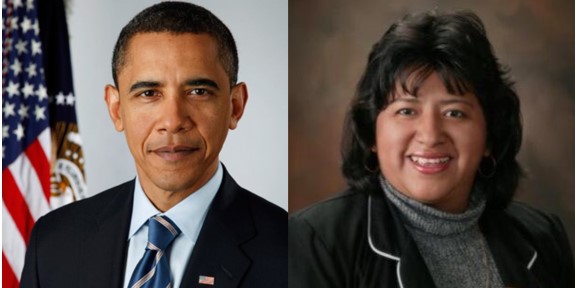
It would be just an amusing story about government bureaucracy—if it weren’t for the dark undertones. It was about a year after I had married my Mexican bride. We were at the immigration office for her permanent residency interview. (She has since become a citizen.) The interview itself had gone smoothly; no, our interviewer really did not want to take a look at our second album of wedding photos. All that was left was to go to the office next door to complete the FBI background check form.
We were the only “clients” in the office. So, one of the staff came over to help her fill out the form. The usual questions about address, previous names, etc. But then we got to the question about race. At first she wanted to answer “Black,” reflecting her dark-colored skin. However, “Black” refers just to people with African ancestry. Next she considered “Native American”; she clearly has plenty of indigenous ancestry. However, “Native American” refers only to members of a tribe recognized by the United States government. Thus, indigenous people from Mexico are not ‘Native Americans.’ Nor does she have any Asian or Pacific Islander ancestry. That left one remaining option.
It felt crazy, but the older lady helping us gently insisted. On the official, penalties-for-providing-false-information-to-the-FBI form. According the United States government, my wife is not ‘Black,’ ‘Native American’ nor ‘Asian.’ By process of elimination that makes my chocolate-skinned wife legally ‘White.’
The American concept of race
I never thought much about the concept of race growing up. Just check the box on demographic forms and move on. I never wondered why we divide people into four or five distinct racial categories. That changed after I started interacting with Latinos and spent time in Mexico. During Mexico’s colonial period, the Spanish overlords imposed a social hierarchy of distinct racial categories. But Mexicans got rid of that a long time ago.
My first time seeing a Mexican goverment form surprised me. It asked about religion but not about race. Nor even about hair or eye color. But then again, those categories have little meaning in a place like Mexico. Most Mexicans have a mix of European and indigenous ancestry, giving them brown skin and black hair.
People from other countries often find the American concept of race puzzling. For years my wife wondered why there are ‘Blacks’ with lighter skin than her. The 44th president of the United States is half Irish American yet is considered ‘Black,’ not ‘Irish’. Furthermore, Barak Obama almost certainly has more European ancestry than my ‘white’ spouse. My engagement with Latinos and their culture has led me to view race in a different light. Now, I also find peculiar the American obsession over classifying people into a handful of distinct races. Especially as all the ‘scientific’ justifications for racial categorization have been long debunked.
Race and DNA
Racial distinctions can’t be found in our genes. True, people from West Africa show more genetic similarity to each other than to people from China. But the genetic differences between people from different parts of Africa can be greater than that between Chinese and French. After all, both the tallest and the shortest people groups in the world live south of the Sahara Desert.
Genetic identification involves identifying different versions of certain sets of genes. There are some genes that result in skin cells producing greater amounts of melanin. This gives some people naturally darker skin than others. As multiple genes are involved in the process, there is a variety of different possible combinations. This results in a range of skin tones. There are also some genes where the different versions have no impact on how cells in a body function. These are the genes that are used in genetic identification, such as taking an ancestry test.
Regional gradations
Determining genetic ancestry is not an exact science. There are amusing stories about siblings—and even identical twins—receiving different genetic ancestry profiles. There is no specific ‘Black’ or ‘White’ or ‘Asian’ gene. Nor are there, for the most part, genetic variations that are unique to a particular region. Rather, genetic ancestry companies rely on statistical models utilizing how the the frequencies of different genetic variations shift from region to region.
And as you move from one region of the world to another, you won’t find any sharp dividing lines. Going from West Africa to eastern Africa, skin color and facial features change gradually. This same sort of transition continues as one moves up the Nile to darker skinned Arabs in Egypt then on to lighter skinned ones further along in the Middle East. The trend continues moving up through Iran to Georgia and Russia, to the very definition of ‘Caucasian’. No sharp, clear-cut boundaries anywhere along the continuum.
The scientific father of race
The choice of “Caucasian” to refer to white Europeans can be traced back to Johann Friedrich Blumenbach. This German naturalist had acquired a rather large collection of human skulls. The one he considered the most beautiful was that of a Georgian woman from the Caucasian region. Thus was born the ‘Caucasian’ race.
Blumenbach built upon the recently developed taxidermical system in biology, dividing human beings into five subspecies. He also measured the size of the brain case of each of his skulls and calculated the average for each race. Surprise, surprise, he found his ‘Caucasian’ skull average to be (barely) the largest. In deeply flawed, biased reasoning he claimed this ‘proved’ Caucasians to be the highest of the race, as his drawing below illustrates.
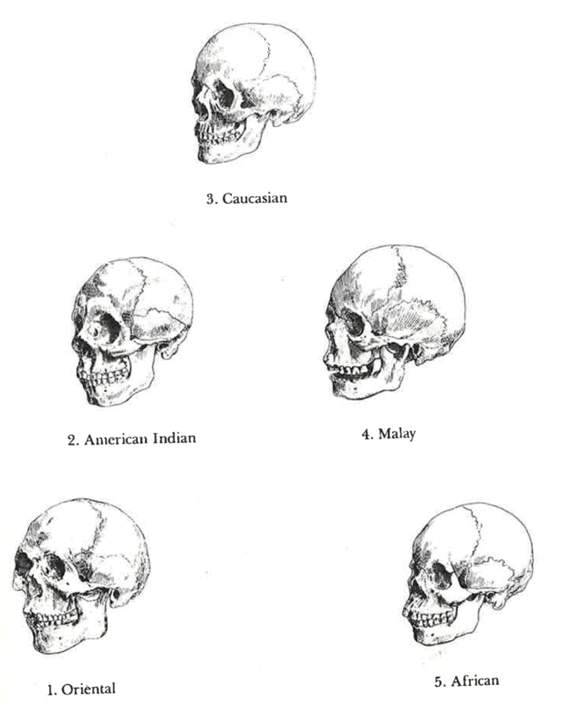
Blumenbach falsely assumed brain size correlates to intelligence. Careful scientific studies have found no evidence to support that idea. They also raise raise troubling questions about whether there even exists a scientifically measurable construct of ‘intelligence.’ But no one questioned his claim at that time due to an insidious cultural bias.
The politics of race
Blumenbach lived in Europe during the eighteenth and nineteenth centuries. European nations were setting up colonies in Africa, Asia, and the Americas to economically exploit them. Slavery was well established in the United States, the Caribbean and other places. The ‘Caucasians’ the top of the system benefited economically from the systematic exploitation of the ‘lesser’ races. Supposed ‘scientific’ findings such as those of Blumenbach helped justify the system.
The American concept of race that I absorbed growing up has roots in history, not biology. A history we’d rather not think about too much. A history of legally sectioned discrimination and exploitation of certain groups based on their ancestry and skin color. As a result, properly classifying people according to their race used to be very important. Thus began the American obsession with enforcing arbitrary racial distinctions.
Scripture and race
There is neither Jew nor Gentile, neither slave nor free, nor is there male and female, for you are all one in Christ Jesus. (Galatians 3:28)
There are plenty of passages in the Bible that speak against dividing people up by race. In the first chapter of Genesis, God creates all of humanity in his image. The United States’ Declaration of Independence echoes that, declaring “all men are created equal.” (Something Martin Luther King and others were constantly pointing out.) In his letter to the Galatians Paul declared, “There is neither Jew nor Gentile, neither slave nor free, nor is there male and female, for you are all one in Christ Jesus.” In the last book of the Bible, John describes a scene with people from “every nation, tribe, people and language” in heaven worshiping God.
My engagement with Latino culture and history has given me a different perspective on the American concept of race. When we grow up with something, we tend to not question it as it seems to be the natural order of things. Yet race is not really something rooted in biological reality, but in a cultural history of legally sanctioned exploitation of certain groups. Something that Christ came to redeem us from. My chocolate-skinned wife being told that she’s “white” is an amusing story. Except that it reflects a history that is not.
Further reading
“Climate to Crania: science and the racialization of human difference” from Foreign Bodies: Oceania and the Science of Race 1750-1940 by Bronwen Douglas (ANU Press. 2008).
Fatal Invention: How Science, Politics, and Big Business Re-create Race in the Twenty-first Century by Dorthey Roberts (The New Press, 2012)

Leave a Reply