Occasionally students ask questions that catch me off guard. Years ago, we had just wrapped up a discussion of science history in my conceptual physics class. One student raised his hand in response to my asking if there were any questions. He wanted to know why science had started in Europe as opposed to somewhere else.
Good question. We like to tell our students that science is universal, that everyone can do it. Yet if we examine the great scientists over the last few centuries, we will find they are almost exclusively white—and mostly men. Students—particularly minority ones—have legitimate grounds for wondering if that claim is actually true.
The importance of ideas
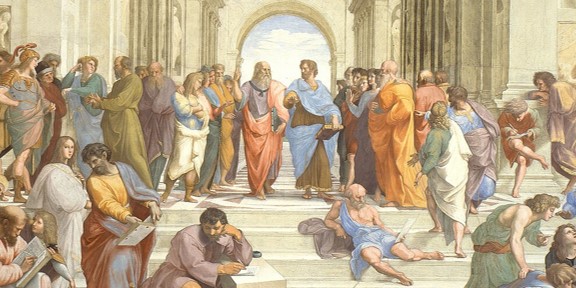
I stammered out that a key reason was the Greek philosopher Aristotle. (Someone who we had already studied). Aristotle deeply influenced the European intellectual tradition, and Aristotle was interested in the fundamental nature of things.
Other cultures also had philosophers that deeply shaped their development, for example Confucius in China. But Confucius philosophized about different themes, such as how to organize a healthy, harmonious society. That shaped the historical development of Chinese society and culture in different directions.
Years later, I had the opportunity to study the cultural origins of modern science. I had correctly told that student years before that Aristotle was key. Aristotle’s emphasis on logical, evidence-based arguments and explaining natural phenomena in terms of natural processes lay down an important foundation. But Aristotle alone was not enough.
Learning in the “dark ages”
The collapse of the western half of the Roman Empire led to a sharp drop in education and scholarly activity. The new rulers were more interested in fighting than studying, and the complex political and economic structures that sustained Roman economic activity crumbled. Much of the reduced economic output was dedicated to warfare or just surviving, with little leftover for education.
Learning didn’t totally disappear, though. The eastern part of the Roman Empire continued to function. The Islamic world collected and built on Greek, Persian and Hindu scholarship. In Western Europe monasteries began appearing and soon would start copying more than just Bibles. Charlemagne not only unified much of western Europe but also ordered the establishment of schools at each cathedral. He knew both the church and his government needed educated young men.
Life got a little better after the turn of the millennium. Greater political stability and competence combined with improved agricultural methods and tools improved economic output. Cities grew and gained greater status. The better economic conditions allowed for a revived interest in education.
The Medieval University
As the thirteenth century approached, guilds of teachers in Bologna, Paris and Oxford organized themselves into the first universities. By the end of the thirteenth, the concept had spread across Europe. There was just one undergraduate curriculum organized around the seven liberal arts: grammar, logic, rhetoric, arithmetic, geometry, astronomy, and music (theory).
The vision of the university was to revive classical learning. Consequentially, instruction on each of the liberal arts was based on Latin translations of one or more classical works. Courtesy of a dedicated band of translators who translated them into Latin from Arabic translations captured during the Reconquista of Spain. Pythagoras for music. Ptolemy for astronomy. Euclid for geometry. But above all, Aristotle.
Aristotle wrote on a wide range of topics, from logic, rhetoric and ethics, to physics, cosmology, natural history and psychology, and more. Aristotle did not merely supply the texts for logic and rhetoric, but he also came to provide the entire intellectual framework for medieval scholarship. Medieval scholars adopted Aristotle’s metaphysical foundations, his form of evidence-based reasoning, and his goal of explaining the world around us.
The Parisian Objection
But not everyone embraced the new ideas. The University of Paris forbade teaching Aristotle until the middle of the 13th century. Eventually they had to relent as most other universities embraced Aristotle. But the concerns did not go away. The bishop of Paris set up a commission to investigate them. This resulted in him issuing in 1277 A.D. a somewhat disorganized and repetitive list of 219 forbidden theological and philosophical claims.
Certain points of Aristotle’s philosophy flew in the face of basic Christian doctrine. Aristotle claimed that cosmos had always existed with no beginning, eliminating the need for a Creator. The divine or spiritual had no place in his thinking. Aristotle’s concept of the “soul” is more of a life force combined with internal psychology. As one might expect from someone who lived three centuries before Jesus in pagan Greece, Aristotle was no Christian.
A synthesis
Still, the scope and sophistication of Aristotle’s body of work could not be denied. Nor did Western Europe have any comparable intellectual system. Other scholars got to work trying to reconcile Aristotle with Christian doctrine. Most importantly, Thomas Aquinas’ Summa Theologica and other works synthesized the two.
Aquinas’ synthesis worked because Christian theology and Aristotelian philosophy overlapped in critical ways. This included key foundational beliefs about the physical world that were foundational for the rise of modern science.
A rational world
Aristotle’s works on natural philosophy assumed that the physical world was logical and orderly. That consistent, unchanging physical principles govern the behavior of the world around us. And that we can deduce them using observation and logic. A far cry from the metaphysics of Greek legends that portrayed the world as controlled by capricious gods who acted on whims. Trying to do science in a world governed by emotional gods who change their minds instead of consistent principles would be a fool’s errand.
That the world around us behaved according to consistent, rational, and naturally observable principles provided a key starting point for Aristotle, as well as modern science. But he could provide no philosophical or theological justification for that assumption. Modern science’s fantastic track record has convinced us that the world does behave according to such principles. But it also can offer no explanation as to why it has those characteristics in the first place. Albert Einstein wrote, “the world of our senses is comprehensible. The fact that it is comprehensible is a miracle.”
A rational Creator
In contrast, Christianity does offer an explanation. The biblical creation account describes the physical world as something distinct from the divine. It makes clear that the sun is an inanimate object, not a powerful god. The Bible expresses in multiple places the idea that God designed the world through wisdom. For instance, the book of Proverbs’ extended prologue declares:
By wisdom the Lord laid the earth’s foundations,
by understanding he set the heavens in place;
by his knowledge the watery depths were divided,
and the clouds let drop the dew. (Proverbs 3:19-20)
Christian doctrine asserts that we can explain the physical world using human logic and reason because God created it using divine logic and reason.
An empirical science
Yet at the same time, pure reason is insufficient. Aristotle grounded his natural philosophy in observations and other pieces of empirical evidence to back up its claims. Aristotle rejected the belief of his teacher Plato that one could determine through pure reasoning how the world necessarily had to be. Though far from being totally consistent, Aristotle’s example set a precedent for using empirical observations to study the natural world.
Medieval theologians and philosophers reinforced this idea. The Franciscan frier Roger Bacon became the first European to write about “experimental science.” His 1267 Opus Majus, written at the request of Pope Clement IV, ranged from optical theory to biblical translation. He even included a section describing his own careful observations of rainbows. While his concept of ‘experimental science’ still needed considerable development and refinement to become that of modern science, it provided a start.
Bacon wasn’t alone. A call for what was at the time a radically empirical approach to studying came from William of Ockham. This controversial theologian, best known for Ockham’s Razor, held a very high view of divine sovereignty. Thus, he insisted that God could have created the world however he chose. Therefore, only through empirical observations of the world around us could one come to know how God designed it.
A good, good world
Ancient Greek culture, like many others, generally held a dualistic view of reality. The physical, mundane world was ‘bad’ and the spiritual/intellectual world was ‘good.’ The goal of stoic philosophy was, crudely, to divorce oneself as much as possible from the former to focus as much as possible on the latter. Once again, Aristotle bucked that trend by writing far more extensively about the physical world than most other Greek philosophers. He thought the physical world was worthy of his attention.
Christian theology asserts that the physical world was good and worthy of study. Seven times in the Genesis creation narrative God declares what he has made to be ‘good.’ Then at the end he declares it as ‘good, good,’ turning the adjective into a superlative. Medieval theology believed many things in the physical world served as symbols pointing to spiritual truth. ‘Real world’ entities from pelicans to (presumed) unicorns became symbols of Christ and other spiritual truths. Studying the created order as well as scripture revealed truth about God and our spiritual reality.
Laying the foundation
Thus, Aristotelian philosophy and Christian theology mutually reinforced several foundational metaphysical beliefs critical for the development of modern science.
- Logical, consistent, natural principles govern events in the world around us instead of gods and spirits that act in inconsistent and sometimes capricious ways.
- We cannot figure out how the world works through pure mental reflection (as Plato believed) and so must empirically study it.
- The physical world is good, making knowledge about it worthwhile of devoting time and effort to study it.
Francis Bacon, Galileo, Kepler, Newton and other 17th century scientists did not develop these foundational metaphysical beliefs. They inherited them from medieval natural philosophers who centuries before had reconciled Aristotelian natural philosophy with Christian theology. Two intellectual frameworks that clashed on certain points but overall developed a deep resonance.
Aristotle had tacked against the cultural tide of his age. A good start, but not enough to develop anything resembling modern science. But when upon his rediscovery in the medieval university, Christianity had sifted the cultural tide. The seed of his thought could germinate and put down roots in Christian Western European thought. Roots that then sprouted with the emergence of modern science in the 17th century.
But why Western Europe?
Yet this does leave one big question: why Western Europe? The Eastern Roman (Byzantine) Empire, also professed Christianity and never lost access to Aristotle. The Islamic world held a very similar theological outlook on the physical world and had access to not only Greek but also Persian and Hindu scholarship since the ninth century. Yet, in spite of occasional flashes of brilliance, neither came close to developing something akin to 17th century science.
That is an important question, and one that has ramifications for today. It has to do with how the tension between Aristotle and Christianity played out differently in Western Europe. But that is a subject for a future post.
Notes and references
Edward Grant, The Foundations of Modern Science in the Middle Ages: Their Religious, Institutional and Intellectual Contexts (Cambridge University Press, 1996)
Albert Einstein, “Physics and Reality,” 1933, reprinted in Daedalus, Vol. 132, No. 4, On Science (Fall, 2003), pp. 22-25
Leave a Reply