We fought a lot early on in our marriage. Well, kind of fought. She would lash due to feeling overwhelmed and unloved. I responded with avoidance and retreating further into my shell. Needless to say, neither approach solved the conflict. We played the blame game, determined not to lose. In the end, we both did.
As humans, we naturally blame others and absolve ourselves when we find ourselves in conflict. Our brains are wired that way. Our cognitive biases lead us to prefer overly simplistic explanations over messy, honest ones. We more easily see things from our own perspective than someone else’s. We want to believe that we are pretty good people and tend to ignore evidence to the contrary. And many of us carry around insecurities that make it hard to admit our fault.
Galileo vs. the Pope
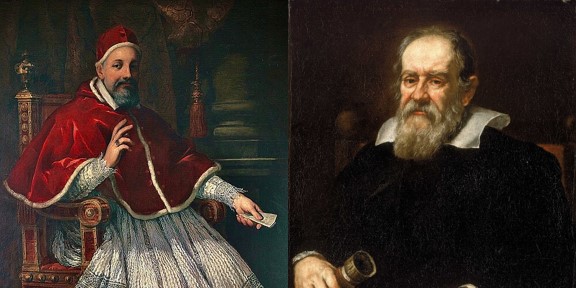
History is full of flawed, insecure people who respond to slights—real and imagined—by attacking others. For example, Galileo and the church. Or more accurately, Galileo and Pope Urban VIII. Despite what you may have heard, their conflict was far more complex—and personal—than “science vs. religion.”
Pope Urban VIII would have appeared to have been on top of the world. Being the head of the Catholic Church and ruler of the Papal States made him one of the most powerful men in the world. He had consolidated his power through installing relatives and allies in many key positions in the church. His shrewd diplomacy and military campaigns expanded the territory he directly ruled. Being a poet and patron of the arts made himself a foci of artistic and literary output. Even the world-famous astronomer Galileo had dedicated a scientific treatise to him, which then blossomed into a friendship.
But trouble lurked beneath the façade. His military adventures and grand building projects had strained the Papal States’ treasury. This lead to his subjects grumbling about high taxes. His territorial expansions created tensions with the neighboring states. And then the conflict known as the Thirty Years War put him in a serious bind.
Religion and war
A century before Martin Luther had kicked off the Protestant Reformation. The Catholic Church eventually reformed the egregious practices that Luther had called out but doubled down on theology. By Galileo’s time most of the northern half of Europe had bolted from the Catholic Church. This, of course, reduced the reach of its wit and the tithes it collected.
The Catholic-Protestant divide also created a tinderbox in the Holy Roman Empire, the political Frankenstein “uniting” central Europe and northern Italy. The hundreds of political entities that composed it selected the next every time the throne became vacant. And they, not the central state, maintained standing armies. Most of the northern part had become protestant, while the southern part remained Catholic. Then in 1618 the recently crowned Emperor Ferdinand II tried to reverse this by military force. His ultimately unsuccessful attempt unleashed one of the most devastating civil war in European history.
Naturally, Emperor Ferdinand expected to receive support from other Catholic leaders. His cousin on the Spanish throne—flush with gold and silver from Mexico and Peru—willingly supported him in the conflict. But the pope’s support was conspicuously absent.
The Pope and the Hapsburgs
Pope Urban VIII had reasons to be wary of the powerful Hapsburg family. Members of it sat on the thrones of both Spain and the Holy Roman Empire, controlling vast swaths of Europe and the Americas. As a result, the French government feared the power of the Hapsburg family far more than the existence of Protestantism in a foreign land. And the pope was a francophile. Not only had he spent fond years in Paris as the papal ambassador, but the politically shrewd French prime minister was also a Cardinal in the Catholic Church.
Closer to home, the Pope’s territorial expansion efforts had created tensions with his neighbors. To the south lay Naples, a territory that was part of the Spanish Empire. To the north lay Galileo’s home country of Tuscany. The Grand Duke of Tuscany, Galileo’s patron, was nominally allied with the Holy Roman Empire. And his marriage gave him a potential claim to territory the pope had simply occupied and annexed for himself.
And then were the Spanish. The wealth it extracted from its colonies in the Americas made it the most powerful empire in the world. And unlike in most of the rest of Europe, the Spanish branch of the Catholic Church closely aligned itself with the state. Unsurprisingly, the Spanish Cardinals loudly criticized the pope’s lack of support for the Catholic side in the conflict. So much so that Pope VIII even employed food tasters to guard against poisoning.
A fading astronomer
Galileo, too, had reasons to feel insecure. Two decades had passed since his astronomical discoveries had made him the toast of Europe. Astronomy had since moved on without him. The Protestant astronomer Johannes Keplar, heir to Tycho Brahe’s immense set of astronomical data, had determined that planets moved in elliptical, not circular orbits. The Jesuit astronomer Christoph Scheiner had conducted a far more extensive study of sunspots than Galileo (who originally discovered them) had ever done. Yet Galileo, now an old man beset by chronic illness, couldn’t accept, much less celebrate, the achievements of others. His position as the Grand Duke’s court philosopher and mathematician carried the responsibility to bring honor to his patron. But a decade had passed since he had published anything of significance.
And then there was the Edict of 1616. This official Catholic decree prohibited Catholics from teaching Copernicus’ heliocentric model of the cosmos as true. In part, Galileo only had himself to blame. His passionate and somewhat tactless arguing for Copernicanism decades before had forced the Church’s hand. Copernicus’ sun-centered cosmos up ended a millennium of astronomical tradition and raised questions about biblical interpretation. But it had remained largely an academic conflict until Galileo had thrust it into the public sphere.
Galileo dutifully complied with the edict–in public. In private he railed against his “enemies.” Finally, he managed to extract from Pope Urban VIII permission to publish on the topic. A key caveat was that the Copernican model had to be presented strictly hypothetically.

A flawed masterpiece
After a long gestation, Galileo finally published one of the greatest scientific books of all time. Nominally, he complied with the Edict of 1616, even claiming in his preface to be defending it. But even a casual reader can recognize where his sympathies truly lay. Step by step, the character advocating for the Copernican model dismantled the opposing arguments for a stationary earth with logic and scientific evidence. Meanwhile, the defender of the sun-centered Aristotelian view offered only sputtering arguments that collapsed like a house of cards. By the end of the book, the obligatory declaration that the argument for Copernican was unconvincing rings hollow.
Yet Galileo’s work contains significant flaws. He disingenuously conflated Tycho Brahe’s hybrid model of the cosmos with that of Aristotle. Galileo had no real argument against the Tychonian model, just personal antipathy. And he weaseled out of actually addressing the leading Tychonian argument against Copernicus because he had no answer. This was not a trivial matter. Many leading astronomers of the time, such as Christoph Scheiner, held the Tychonian system to be correct. And what Galileo offered as his supposedly clinching argument, his theory of tides, was both intrinsically flawed and just plain wrong.
But perhaps Galileo’s greatest error was making his defender of Aristotle into an idiot. Galileo’s character comes across as a bubbling fool who needs things explained again, who opens his mouth only to insert his foot. Helpfully, Galileo gave him a name that closely resembled the Italian word for “simpleton.” To add insult to injury, Galileo had this character deliver the pope’s favorite argument about the limits of human knowledge compared to the divine. The argument that had been one of the Pope’s conditions for granting permission to write the book in the first place comes from the mouth of a fool.
A bitter cup for all
Over the years Galileo’s combative style and acid wit had earned him many bitter enemies, as well as passionate supporters. Some of those managed to convince Pope Urban VIII that Galileo had both overstepped the bounds and personally attacked the prelate. Galileo’s confession during his trial to have gotten too carried away in his arguing came too little, too late. The pope, under great strain and smarting from the perceived betrayal, resolved to make an example out of Galileo.
The final judgment devastated Galileo. Confined to house arrest the rest of his life and all his works band, he feared that history would forget him. While temporarily triumphant, Pope Urban VIII’s rush to judgment also left a bitter legacy. Despite his many accomplishments, Pope Urban VIII is perhaps best remembered as Galileo’s antagonist. Galileo’s condemnation had a chilling effect on Catholic scientists and gave scientifically-minded individuals another reason to reject Catholicism. This only accelerated the shift of nascent modern science from Italy to England and other protestant lands. And it provided great fodder for those who sought to (misleadingly) portray Christianity, and the Catholic Church in particular, as being virulently anti-science.
What a shame, as both claimed to be serving divine purposes. One as God’s representative on earth, the other as a defender of truth. They put great energy into a conflict over the interpretation of certain biblical passages while ignoring the wisdom of other, unambiguous ones. Passages like Proverbs 15:1, “A gentle answer turns away wrath, but a harsh word stirs up anger.” Or James 1:19-20, “Everyone should be quick to listen, slow to speak and slow to become angry, because human anger does not produce the righteousness that God desires.” A friendship built on a shared love of literature and learning was incinerated on the altar of pride. Both fought to win. But in the end, everyone lost.
Further Reading
Dialogue Concerning the Two Chief World Systems: Ptolemaic and Copernican by Galileo (1632). English translation by Drake Stillman (Modern Library, 2001).
Galileo’s Daughter: A Historical Memoir of Science, Faith and Love by Dava Sobel (Bloomsberry, 2009).
Setting Aside All Authority: Giovanni Battista Riccioli and the Science against Copernicus in the Age of Galileo by Christopher Graney (University of Notre Dame Press, 2015).
Leave a Reply