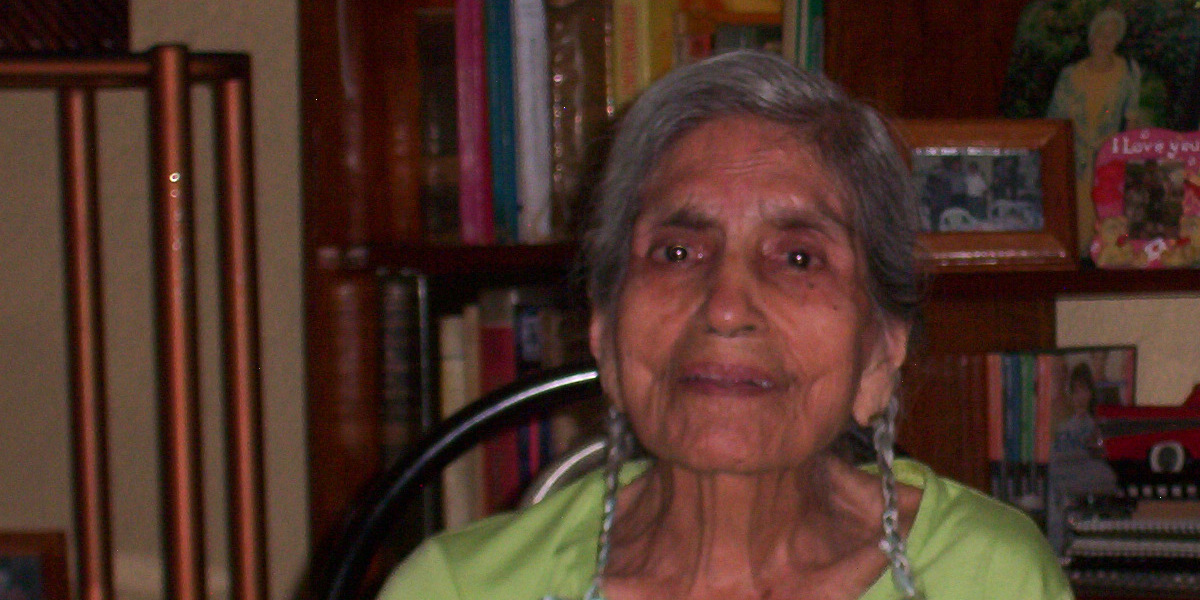
At first glance, she seemed like an ordinary person. She was an old, tiny woman, her brown face wrinkled, her black hair turned gray. She could have been bitter after a lifetime of hardship. She never knew her father and had to leave school early to help her mother make ends meet. Through hard work she managed to build a business in her small town. Her first husband ran off with the servant girl, and her second treated her abusively and carried on affairs. Yet she endured his behavior for a couple of decades, wanting her children to know their father. And then in her seventies she developed breast cancer.
But there was a sparkle in her eyes and joy in her voice as she told me her story. Not about what she had accomplished, but what she had received. Two and a half decades later I can still picture her vividly. She stood there in the middle of her living room, the top of her head reaching only to the level of my chest. Her finger pointed upward, and a smile threatened to bisect her face as she told me about what happened to her cancer.
A tumor goes missing
My wife’s grandmother had initially paid no attention to the lump in her breast. Finally, it grew to the point that one of her children noticed and took her to see a doctor in Mexico City. By then, the tumor had grown too big to operate. Instead, they prescribed her a course of chemotherapy. The hope was that the medicine would shrink the tumor enough for surgical removal.
However, the side effects kicked in after just a couple days of the medicine. She had already lived for more than seventy years and had a mind of her own. She decided she wasn’t going to come to the end of her life suffering from the side effects of chemo. So, she just stopped taking the medicine. She declared that if she was going to be healed, Jesus would have to do it. But she still went to the follow-up appointment with the doctor a month later.
As she got to this point in the story, her smile somehow grew even wider. An astonished nurse had returned with the mammogram results and asked her, “Ma’am, which saint do you pray to? Your tumor has completely disappeared!” But my wife’s grandmother was a life-long evangelical Christian, a minority in a heavily Catholic country. I can still see her waving a bony finger in the air as she repeated her reply with a huge smile, “None of them. Only Jesus. Only Jesus.”
Reasons to believe
I have no doubts that she received a miracle. She was a humble, devout woman with a deep prayer life. I heard her tell the story with my own ears. Everyone in the family knew about it, along with many people in the town. I’ve never heard anyone dispute the facts. Furthermore, this wasn’t part of any organized religious spectacular. Nor did it involve a twisted theological belief that utilizing modern medicine is somehow unspiritual. But it was comments made a few years later by her eldest son that really clinched the case for me.
My wife’s uncle, like me, had pursued a career in science. First as a teacher, and then later as a researcher, eventually earning a PhD in biochemistry. He served as a research scientist at the Instituto Politécnico Nacional, one of Mexico’s world-class research facilities. He conducted scientific work on the biochemistry of dengue, a devastating mosquito-borne tropical illness common in southern Mexico. He was part of a large effort to develop science-based medicine to combat that illness.
Like many scientists, he also held a materialist viewpoint (back then). He didn’t believe in the existence of God or any spiritual reality. But he also personally knew his mother’s story. A few years later during a family gathering while we were visiting, the topic of his mother’s cancer came up. Unprompted, he commented, “I saw the x-rays before. I saw the x-rays after. There is no scientific explanation for what happened.” The evidence had forced him to admit that she had experienced a miracle. Even though his belief system held no place for such a thing.
Miracles and science
Miracles are things for which there is no scientific explanation. They may involve events that contradict what we know about how the physical and biological worlds work. For example, large tumors disappearing without a trace. Alternatively, they could have natural causes but involve impossible coincidences. Some have suggested that a naturally occurring earthquake caused the walls of Jericho to collapse the moment Joshua and his group blew their horns. Now, both earthquakes and massed horn-blowing are pretty infrequent events with absolutely no casual connection. The chances of both randomly happening at the same time and place are unimaginably small. Miracles defy scientific explanation.
You might then ask, “But how can you, as a scientist, believe in miracles?” Good question. For years, some have pushed the idea that science and religious faith are incompatible. Prominent voices have claimed that science ‘disproves’ religion or that ‘science’ is just a cover for atheism. But those claims rest on unstated assumptions about the nature of science and religious faith. Assumptions about the scope of science and faith. Assumptions that many people aren’t consciously aware of making. And assumptions that crumble under careful scrutiny.
Ordinary and extraordinary events
Science is based on empirical observations of the world around us. We observe an event over and over, or a whole set of related events. Then, from these repeated observations, we deduce patterns about how the world around us works. Students in my conceptual physics course work together as a class to collect a set of data on how light bends when entering a block of plastic or glass. From their data, we deduce a mathematical relationship to describe the refraction of light. Of course, our data just further confirms the scientific law that everyone over the last four centuries has observed.
My point is that we construct scientific knowledge on repeated, predictable observations of the world around us. Only with this foundation can we develop laws and theories that describe how the world around us works. The ability of others to reproduce a particular scientist’s work is key to evaluating scientific truth claims.
However, miracles are, by definition, not reproducible events. My grandmother-in-law’s healing violates the normal course of breast cancer. A massive city wall crumbling when a bunch of people blow trumpets and start yelling violates scientific laws about material behavior. And Jesus’ bodily resurrection violates multiple laws of biology and physics.
Miracles violate the normal behavior of the physical and biological world in which we live. And that is exactly the point. They are extraordinary events. Supernatural events. This means they are not ordinary, natural events. Miracles don’t obey the laws of science. If they did, they wouldn’t be miracles. To say that something isn’t scientifically possible doesn’t necessarily mean it can’t happen. It might mean that such a thing simply lies beyond the scope of what science can explain.
The root of science vs. miracles
The claim that science rules out miracles is rooted in Positivism and related philosophical beliefs. Positivism asserts that scientific investigation is the only reliable means of knowing about the world around us. Buried under that is an assumption that the entirety of reality consists of only things and processes that can be scientifically studied. If it is not scientific, it can’t happen. Positivism doesn’t prove that supernatural miracles can’t happen. It simply starts with the assumption that they can’t.
Perhaps you can already spot the fundamental fallacy of such a position. It asserts that the only valid truth claims we can make are those that can be scientifically established. But where is the scientific basis for that claim itself? It’s nonexistent. Positivism doesn’t prove the non-existence of God or any supernatural reality. It simply starts with an (often unstated) assumption ruling out even the possibility. But that’s not how science works.
The anti-science beliefs of some Christians also stem from not examining starting assumptions. They don’t carefully examine the positivistic reasoning and expose the foundational flaw of the ‘scientific’ argument against God. Rather, they blindly accept the flawed argument equating science to materialism and instead attack science itself. Likewise, they also fail to carefully examine their own starting assumptions about what the Bible can and cannot tell us about the world around us. When thoughtfully interpreted, the Bible complements a scientific outlook.
A theistic view of science and miracles
The theistic worldview shared by Judaism, Christianity and Islam asserts that the physical cosmos science studies was created by God as something distinct from the divine. Furthermore, they assert that God employed intelligence and wisdom in the creation:
By wisdom the Lord laid the earth’s foundations,
by understanding he set the heavens in place;
by his knowledge the watery depths were divided,
and the clouds let drop the dew. (Proverbs 3:19-20)
In this worldview, the laws of science don’t just randomly exist as an independent reality. Rather, God designed and implemented them to build a functional, good creation that is also intelligible. Science works because a wise God who values functional order created the laws it studies.
But if God designed and established the laws of science, then he has every right to suspend certain ones if he chooses. No contradiction here. Science serves as a valuable tool for studying the world around us when it functions according to the ordinary manner of the laws of nature. But sometimes, God may have objectives that he can’t achieve through ordinary, natural processes. Nothing stops him from working through extraordinary, supernatural means, i.e. through miracles.
A changed life
My wife’s grandmother lived another three decades after her miraculous healing from cancer. Long enough to tell many people her story, including me. And long enough to experience, perhaps, another miracle.
After years of abuse she finally kicked the father of her children out of the house with their support. Years later, a life of womanizing and heavy drinking finally caught up with him. His daughter (my mother-in-law) heard he wasn’t doing well and went to look for him. She found her father in poor health, living in his office as he had no house. Drawing on her faith to overcome resentment from decades of his abusive behavior, she took him in and cared for his needs.
This unexpected and undeserved love had a profound impact. The former abuser and womanizer repented from his past and became a follower of Jesus. Eventually, this led to a reconciliation with his estranged wife, followed by a wedding. As it turned out, they had never officially married. Years later, I heard of my grandmother-in-law expressing her joy over the reconciliation. After so many decades, the man she had loved finally attended church and glorified God alongside her.
Miracles and God
I don’t know if this reconciliation, after decades of abuse and estrangement, meets my definition of a miracle. Human psychology and behavior are far more complex and mysterious than city walls or even cancer cells. I can’t say with certainty to what extent God worked through ordinary human nature and what extent through extraordinary means. Still, things like that don’t normally happen. Either way, the healing of both my grandmother-in-law’s body and her marriage points to a reality beyond the material world.
Events that defy the laws of science happen. When we call them ‘scientifically impossible’, the emphasis should be on the first word. Labeling them such tells us not about the nature of the reality we live in, but rather the limits of the scientific enterprise. Science works quite well in describing and explaining the ordinary course of the physical and biological reality around us. But it has its limits. It intrinsically can’t investigate extraordinary, one-off events like miracles. We must look elsewhere to explain those. Sometimes to ‘Only Jesus. Only Jesus.’
Notes
In this I reject the use of ‘miracle’ to describe amazing but natural events, such as the normal development of a child in its mother’s womb. While I do believe that such unbelievably complex workings in nature point to a creator, using the word in that way cheapens it from its original meaning.
Leave a Reply